
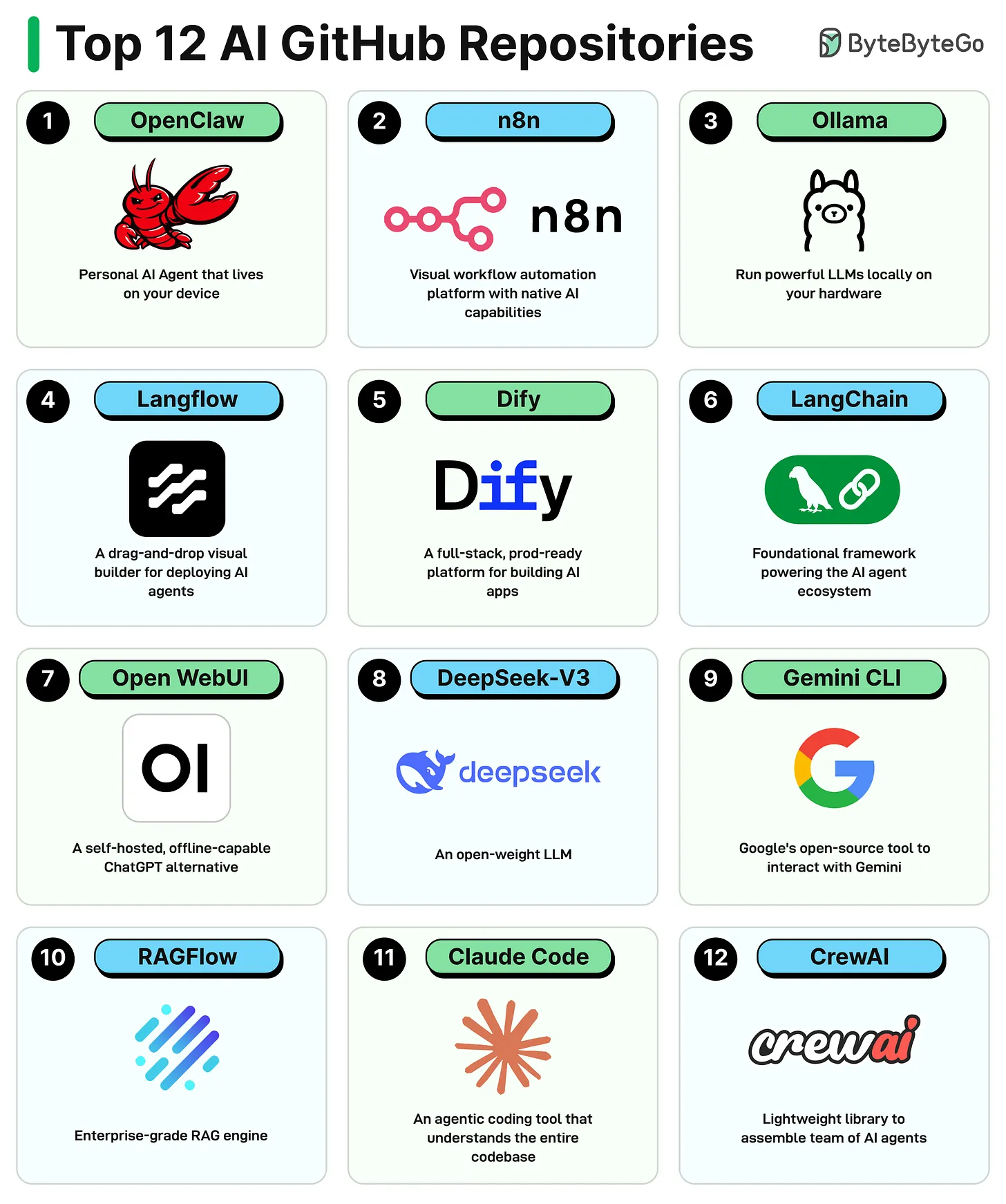
The top 12 most starred AI GitHub repos right now tell a clear story about where the AI industry is - and where it’s heading.
And it will all affect businesses working with AI.
The Infrastructure Layer Is Basically Done
Ollama, LM Studio, and other tools for running models on your own machines are super popular. Open source models are almost as good as the closed ones, even though most of us don’t have the hardware to run the best ones yet.
The foundation is there. The tooling to self-host, fine-tune, and deploy models locally has matured fast. This is no longer the hard part.
AI Agent Toolkits Are Here - But No Winner Yet
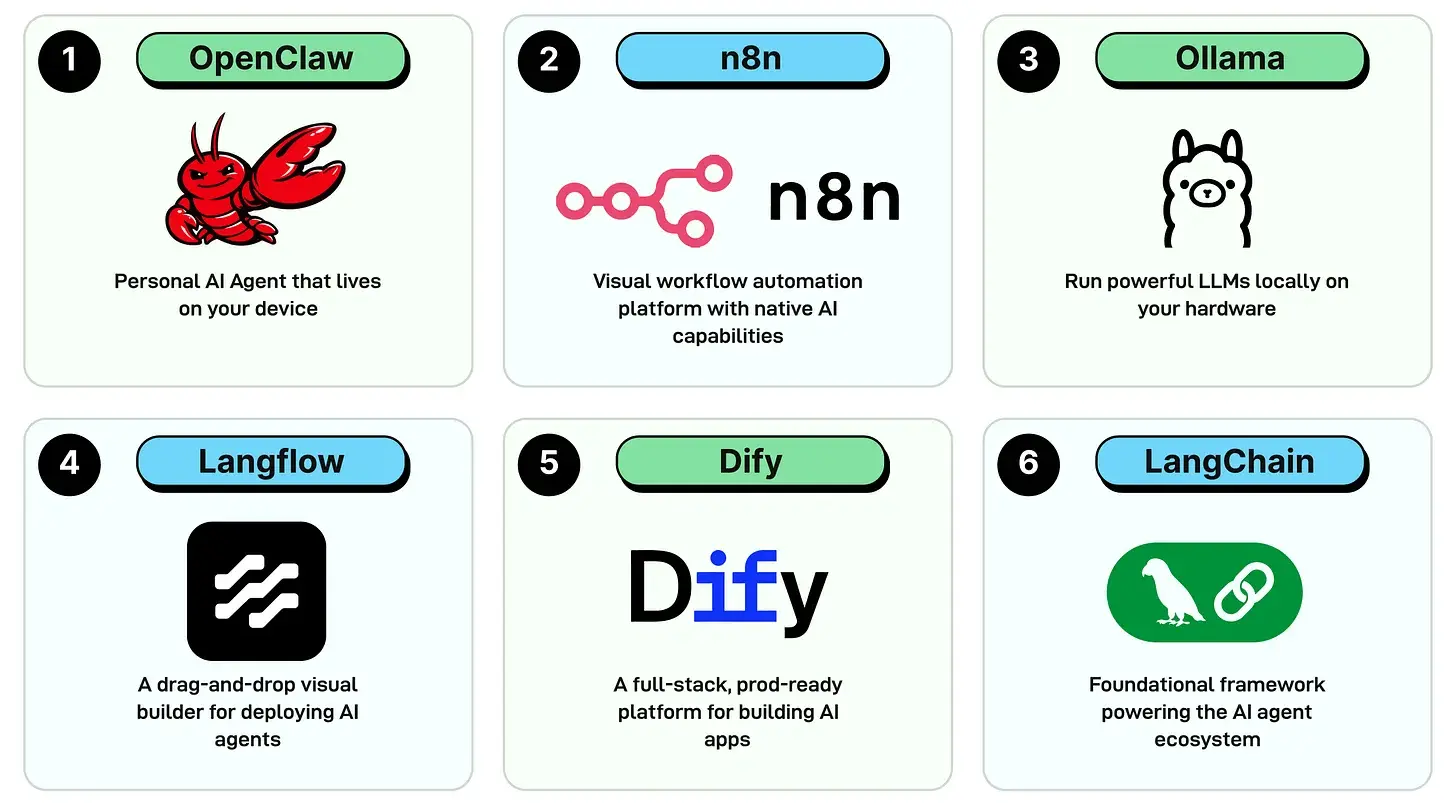
We have a few popular code-level tools for implementing AI agents: LangChain, CrewAI, Dify, and tools like RAGFlow.
I’ve tested all the main solutions. They’re all genuinely great - and if you understand the limitations and development model, you can craft production-ready AI agents with them. But there’s still no clear industry winner.
For now, LangChain (and related tools like LangGraph) feels like the most popular pick.
It’s still pretty common to build agents directly with the OpenAI SDK. But I’d argue that’s no longer the recommended path - tools like LangChain + LangGraph give you almost full control and flexibility without the boilerplate.
The No-Code Layer Is Exploding
n8n, Langflow - visual builders, drag-and-drop agent deployers, full-stack AI app platforms. All trending hard.
The pattern is clear: developers want to build AI systems faster, with less boilerplate. And non-technical builders want in too.
We’re in the “frameworks and glue” era. The same phase web dev went through in the early 2010s with Rails, Django, and the first SPA frameworks. With AI agents being controlled by LLMs, it’s a pretty obvious direction.
That said, we’re currently in the “AI agentic workflows” phase rather than fully autonomous LLM-driven agents running businesses. That’s exactly why code-level tools still have an edge - they give you more control, which is required for production-scale, reliable implementations.
The General Agent Boom
Claude Code, OpenClaw, Gemini CLI - agentic tools are gaining traction fast.
The direction is obvious: AI that doesn’t just answer questions, but actually does the work. Multi-step reasoning, tool use, autonomous execution.
These tools are a genuinely useful productivity booster for solopreneurs and developers. But they’re not yet mature enough for complex, mission-critical business cases at scale. That gap will close.
What Comes Next
An obvious AI agent toolkit leader. We’ll soon see a dominant framework for building AI agents. My bet is it will support both code and no-code implementation interfaces - because the market for both is too large to ignore.
Observability improvements. We already have some useful tracing tools, but regulatory pressure will force companies to track everything their AI does. Those who build solid observability now will be in a much better position to innovate responsibly.
Skills and process-oriented mindset. This is already happening inside tools like Claude Code and Codex - but it’ll become an industry standard for coded AI agents too. Less reliance on generic APIs and MCPs, more ultra-specialized, tuned prompts and instruction sets built around specific tasks.
Specialization over generalization. Right now everyone is building general-purpose agents. The next wave will be hyper-specialized agents that are extremely good at one thing - and that’s where real business value gets unlocked.
Agent-to-agent economy. Agents sharing data, delegating subtasks, and coordinating with each other. It’s the natural next step once single-agent reliability improves.
The GitHub star counts don’t lie. Infrastructure is solved, tooling is maturing, and the race is now about who builds the best abstractions on top.
What are you building on top of these right now?
Kamil Kwapisz
Working on something similar? Let's talk.
Book a call →